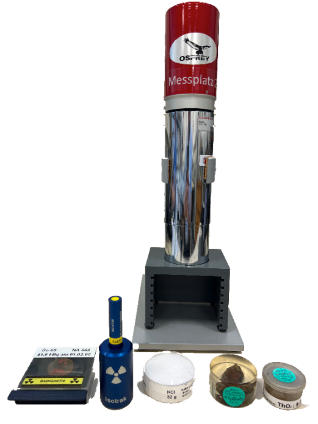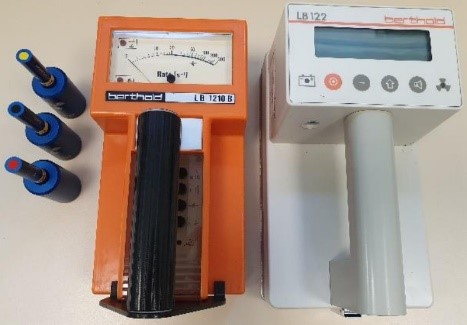
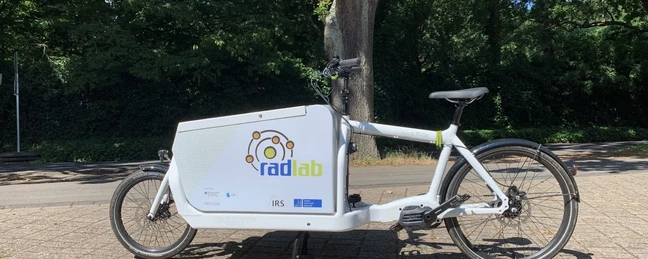
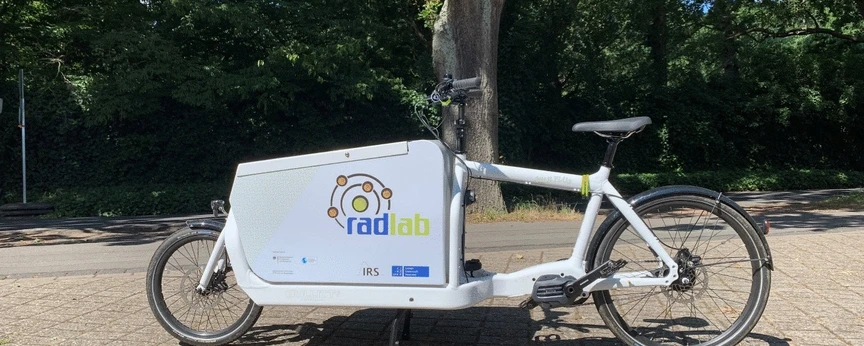
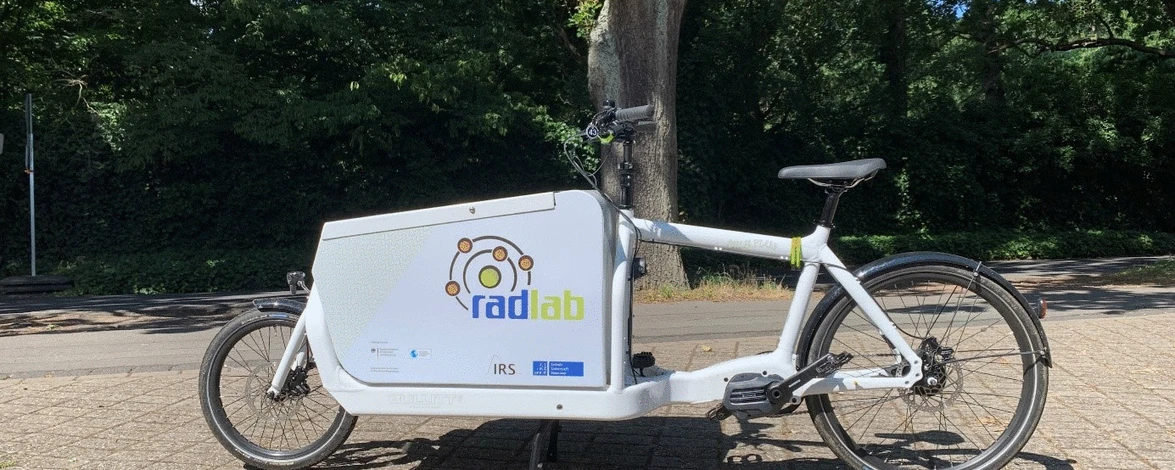
RadLab brings free experiments on radioactivity to schools. In addition, worksheets (including answers) and educational videos are provided to enable schools without the necessary equipment to carry out experiments with radioactive materials. There are experiments on the following topics:
-
Natural radioactivity in food
![Image]()
![Image]()
![Image]()
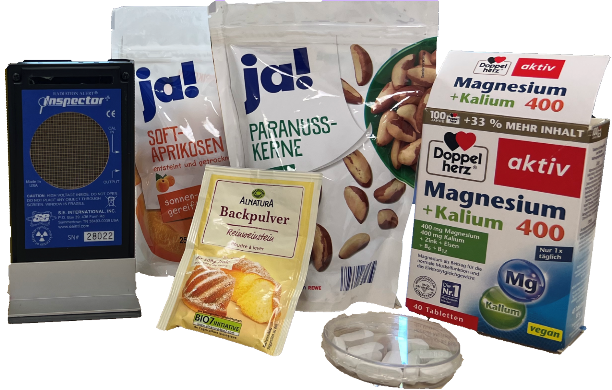
Some radioactive isotopes have chemical properties similar to those of nutrients, which is why plants and animals absorb radioactive isotopes alongside the nutrients they need. As a result, these isotopes also end up in the food we eat every day.
In this experiment, pupils investigate which foods are more likely to contain detectable levels of radioactive isotopes.
-
Radon in ambient air
![Image]()
![Image]()
![Image]()
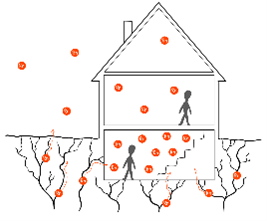
Radioactivity is not only bound to solids, but is also present in the ambient air. The gaseous radon responsible for this, and its decay products, can be collected and measured using static electricity on a balloon or a Philion plate.
Materials:
-
The counting tube
![Image]()
![Image]()
![Image]()
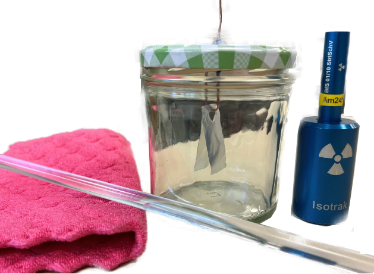
Ionisation chambers, for example, are used to detect ionising radiation. This experiment illustrates how they work using an electroscope. A radioactive sample ionises the surrounding air, causing the electroscope to discharge. In addition, gas ionisation can be demonstrated using a spark gap as a model for a Geiger-Müller counter.
-
Shielding
Different types of radiation interact with matter to varying degrees, which is why they are attenuated differently by the same materials. In this experiment, pupils use type-approved school radiation sources to investigate which materials are suitable for shielding against alpha, beta and gamma radiation.
Materials:
-
Range of ionising radiation
![Image]()
![Image]()
![Image]()
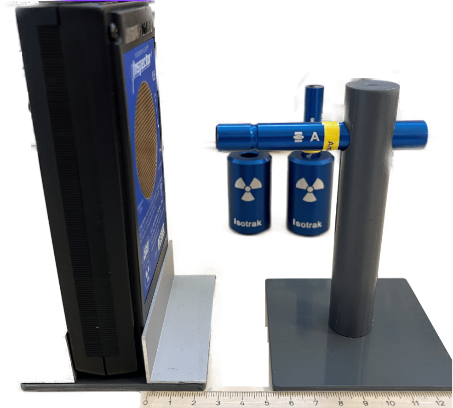
Different types of radiation interact with different levels of intensity with matter, including air. Consequently, they can be detected at varying distances from a radioactive source. In this experiment, pupils use type-approved school radiation sources to experimentally determine the different ranges of the different types of radiation in air.
Materials:
-
Analysis of gamma spectra
![Image]()
![Image]()
![Image]()
The sodium iodide detector consists of a sodium iodide scintillation crystal, which converts ionising radiation into light pulses. It is used to record gamma spectra and, by analysing these, to identify the sample material.
This experiment is suitable for upper secondary school classes.
Materials:
-
Stochastic variations
Nuclear decay is based on the principle of probability. For this reason, the same physical measurements do not always yield the same results. To obtain reliable values, several measurements are taken and the arithmetic mean and standard deviation are calculated.
-
Forensics – Detection of contaminations
![Image]()
![Image]()
![Image]()
Contaminations (samples) are hidden in various places around the classroom. The pupils’ task is to find them using a radiation detector. In doing so, they learn that the different types of ionising radiation vary in how difficult they are to detect, due to their different properties.
-
Environmental samples
![Image]()
![Image]()
![Image]()
In this experiment, pupils are provided with different types of sight glasses containing sealed environmental samples – for example, from nuclear test sites – to examine.
First, hypotheses are formulated regarding the radioactivity of the various samples and a ranking is established. Then, these hypotheses are tested through measurements.
-
Making the effects of radiation visible – cloud chambers
![Image]()
![Image]()
![Image]()
Using our cloud chambers, pupils can visualise the effects of ionising radiation right on their desks and observe the different types of radiation. The different properties of these types of radiation allow different tracks to be observed.
-
Half-life of Pa-234m
![Image]()
![Image]()
![Image]()
In this experiment, the half-life of the short-lived isotope Protactinium-234m is determined. By shaking the apparatus, the decay product Protactinium, which originates from the Uranium-Radium decay chain, is concentrated in the upper part of the setup. Thanks to its short half-life of 1.159 minutes, the decay of the activity can then be measured within a few minutes.
This experiment can only be carried out during a visit to the IRS.
-
Other activities offered as part of RadLab
All the digital resources available here (https://www.strahlenschutzkurse.de/de/behoerden-schulen/angebote-fuer-schulen) can be delivered as part of the RadLab programme under our guidance.
Please feel free to send us an enquiry by email to radlab@irs.uni-hannover.de.
-
Enquiries
Are you interested in having the RadLab visit your school?
Please contact us by email with the following information:
- Should the RadLab be held only in your class or also in other groups at the school?
- How large are the groups?
- How much time do we have available per group?
- Is it an iPad class?
- Which experiments should be carried out?
As a guide: we typically carry out two experiments in 75 to 90 min. These are carried out in small groups. We bring worksheets with us to guide and structure the practical session. These also include evaluation tasks, for which we will provide you with model answers.
We look forward to receiving your enquiries by email to radlab@irs.uni-hannover.de.